Japanese Onsen Etiquette: How to Use an Onsen in 8 Steps
Your first Japanese hot spring should feel relaxing, not like an etiquette exam. Yet the unfamiliar setup—communal nudity, low shower stools, tiny towels, and different tattoo policies—can make even confident travelers wonder what to do next.
The good news is that Japanese onsen etiquette comes down to cleanliness, quiet, and consideration. This guide walks you from the entrance to the changing room in the order you will actually experience it, so you can arrive prepared and enjoy the soak.

Source: Japan National Tourism Organization
The Short Answer: Wash First, Soak Naked, and Keep Towels and Hair Out
At a standard communal onsen, undress in the changing room, wash and rinse your entire body at a shower station, and enter the bath without swimwear. Keep your small towel and hair out of the water, speak softly, and leave your phone or camera outside.
That is the heart of Japanese onsen etiquette. Individual facilities may add rules about tattoos, children, towels, or bath times, so read the signs and check the official website before visiting.
| Situation | What to do |
|---|---|
| Always | Wash fully, rinse off all soap, enter slowly, and keep quiet |
| Ask first | Tattoos, cover stickers, children, private baths, and provided amenities |
| Never | Wear swimwear in a standard communal bath, dip your towel, take photos, swim, or splash |
What to Know Before You Go
You may find an onsen at a traditional ryokan inn, a hotel, a day-use bathing facility, or a hot-spring town. The core manners are similar, but admission, towels, lockers, toiletries, opening hours, and payment methods are facility-specific.
| Before you go | What to do |
|---|---|
| Bring | A hair tie for long hair and water for before and after your bath |
| Check online | Tattoo policy, towels, toiletries, bath hours, private-bath options, and rules for children |
| Store securely | Clothes and valuables in the designated locker, or valuables in your room safe |
Do not wait until you have paid to ask about tattoos. As of July 20, 2026, the Japan Tourism Agency explains that policies vary widely: some ryokan have no restrictions, while others decide case by case.
How to Use a Japanese Onsen in 8 Steps
1. Leave your shoes where the facility indicates
Many facilities ask guests to remove outdoor shoes near the entrance. Follow the signs, and never wear shoes or slippers into the changing room. If you are unsure where the clean floor begins, pause and watch the layout or ask a staff member.
2. Confirm the correct bath entrance and store your belongings
Public baths are generally separated, though the assigned sides may change at some properties. Check the current characters, icons, or English labels every time you enter instead of relying only on curtain color or yesterday’s entrance. Place your clothes and valuables in the designated locker or basket.
3. Undress completely
Standard communal onsen are enjoyed without a swimsuit or underwear. Take only the small towel and any toiletries the facility allows into the bathing area. You may hold the towel in front of your body while walking, but it cannot go into the bathwater.
Feeling self-conscious is normal. Communal nudity belongs to this particular setting, and the considerate approach is simply to give other guests the same privacy you want for yourself.
4. Wash thoroughly at a seated shower station
Choose a washing station, sit on the stool, and wash your whole body before soaking. Shampoo if needed, tie up long hair, remove makeup, and rinse until no soap or conditioner remains. The shared tub is for soaking, not washing.
Be mindful of the hand-held shower so you do not spray the person beside you. When finished, leave the station tidy according to the facility’s setup.
5. Use kakeyu and enter slowly
Before stepping in, use kakeyu: pour hot bath water over your body to rinse and adjust to the heat. The Japan Tourism Agency notes that entering a very hot communal bath too quickly can be uncomfortable and may cause a sharp rise in blood pressure.
Start with your feet and lower legs, then ease in without jumping. An official Hokkaido bathing guide describes onsen water as roughly 37–42°C, but the actual temperature varies. Do not add cold water to alter a shared bath.
6. Soak quietly with your towel and hair out of the water
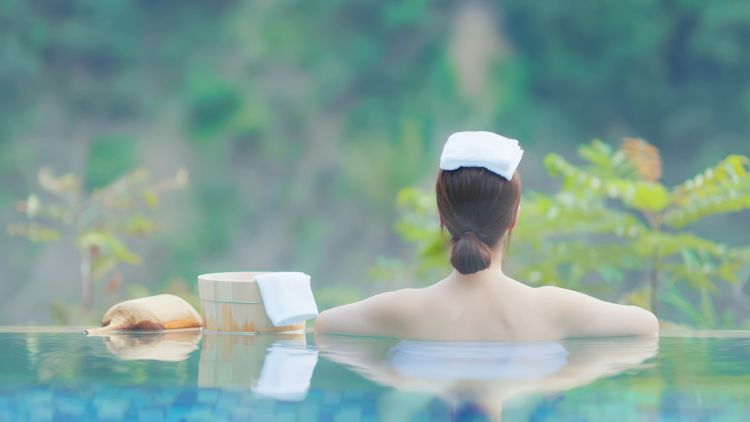
Fold the small towel on your head or leave it on a dry edge where the facility permits. Never dip it in the water or wring it over the bath. Tie up long hair securely, even if it has just been washed.
Source: Japan National Tourism Organization
This is a place for quiet soaking, not swimming. Keep your voice low, avoid splashing, and do not submerge your head. Phones and cameras stay outside—even when you think nobody else is present—because privacy is non-negotiable in a bathing area.
7. Leave before you feel unwell and hydrate
There is no single soaking time that suits every person, bath, and temperature. Get out if you feel dizzy, faint, nauseated, overheated, or otherwise unwell, and take breaks rather than trying to endure the heat.
The Ministry of the Environment’s multilingual precautions advise drinking enough water before and after bathing. They also say to avoid bathing immediately before or after a meal and after drinking alcohol; bathing while intoxicated is dangerous.
If you have health concerns, follow the contraindications posted at the facility and seek advice from a qualified medical professional before bathing. General travel guidance cannot account for your condition or the mineral content and temperature of a particular spring.
8. Lightly dry before returning to the changing room
Use your small towel to remove excess water while you are still in the bathing area. This keeps the changing-room floor drier and safer. The larger towel, if you have one, stays in the changing room for a thorough dry afterward.
Whether to rinse again after soaking depends on the spring, your skin, and the posted guidance. Do not follow a universal internet rule: some mineral water may be left on the skin, while sensitive skin or strongly acidic or sulfurous water may call for rinsing.
Common First-Time Mistakes—and the Easy Fix
If washing in public feels awkward, remember that cleaning your entire body at the shower station is expected. Sit, keep the shower spray close, and focus on your own routine; other guests are there to wash and relax too.
The mistakes that affect others are bringing your towel or hair into the water, making noise, and treating an open-air bath like a photo opportunity. The JNTO onsen guide tells visitors to leave phones outside the bathing area. If the water feels too hot, end the soak rather than adding cold water or forcing yourself to stay.
Tattoos, Body Privacy, and Private Alternatives
Tattoo rules are not universal. A small tattoo may be accepted, assessed individually, or allowed only under a facility-approved cover; another property may refuse entry to the communal bath. Contact the onsen directly and get a clear answer before arrival.
JNTO recommends searching for tattoo-friendly facilities or reserving a private kashikiri-buro. Some onsen sell small cover sheets, but these generally suit only very small tattoos and should not be used unless the property allows them.
A private reservable bath or an in-room onsen can also help travelers who are uncomfortable with communal nudity or gender-separated bathing. An ashiyu, or hot-spring footbath, offers another low-pressure introduction. Confirm clothing, tattoo, reservation, and group-use rules for every private option rather than assuming.
Onsen FAQ
Do I have to be naked?
In most standard communal baths, yes. Leave clothing and swimwear in the changing room. A small towel can provide modesty while walking, but it must remain out of the water.
What is the difference between an onsen and a sento?
An onsen uses water that meets Japan’s legal hot-spring criteria. The Ministry of the Environment defines qualifying water as emerging at 25°C or above, or meeting at least one specified mineral or gas threshold. A sento generally uses ordinary heated water.
Should I wash my hair and remove makeup?
JNTO specifically advises washing thoroughly, rinsing all products away, and removing makeup before entering. If you do not wash long hair, it still needs to be tied securely so it cannot touch the water.
Can I use an onsen during my period?
Policies, products, personal comfort, and individual circumstances differ, so contact the property privately before visiting. A direct answer from the facility is more reliable than a blanket rule online.
Can couples or families bathe together?
Standard public baths are generally separated. Look for a private kashikiri-buro or an in-room bath and confirm who may use it together, whether children are permitted, and whether advance reservations are required.
How long should I soak?
There is no need to chase a fixed number. Enter gradually, take breaks, hydrate, and leave immediately if you feel unwell. Posted health cautions at the facility take priority over generic advice.
Your 30-Second First-Onsen Checklist
- Confirm the facility’s tattoo, towel, and child policies before you go.
- Check the current bath entrance and store your valuables.
- Undress completely and take only the permitted small towel and toiletries.
- Wash your whole body and rinse away all soap and makeup.
- Use kakeyu, then enter the water slowly.
- Keep your towel and hair out of the bath, and speak quietly.
- Lightly dry off before returning to the changing room.
- Hydrate—and leave your phone in the locker before entering the bathing area.
You do not need to perform every custom like a lifelong regular. If you arrive clean, respect privacy, follow the posted rules, and avoid disturbing others, you already understand the part of Japanese onsen etiquette that matters most. Take a breath, enter slowly, and enjoy the quiet.
